
English holly (Ilex Aquifolium) grows up to 40 feet. Although it does best in the Pacific Northwest, it can also be grown in the East in sheltered locations along bays and in some river valleys. It is occasionally successful inland if given excellent wind protection and plenty of shade.
Dahoon (Ilex. Cassine) and yaupon (Ilex. vomitoria) are small trees attaining heights of 40 feet and 24 feet respectively. They are strictly southern plants ranging from North Carolina to Florida.
Japanese holly (Ilex. Crenata) is an extremely handsome evergreen shrub, hardy and similar to American holly in its culture requirements. It has small, rounded, smooth leaves and purple black berries. Convexa is a popular variety, and dwarf varieties include Helleri and Mariesii, Rotundifolia is slightly larger. Most varieties require full sun for best growth and berry formation.
Inkberry (Ilex. glabra), also called winterberry and gallberry, is evergreen in the South Farther North, it turns a rusty green in the autumn. It bears wedge-shaped berries and grows no higher than six feet. The plant does well in sandy garden loam and favors a leaf mulch.
Smooth winterberry (Ilex. laevigata) grows up to 12 feet high and is primarily cultivated for its reddish fruits. Although a southern plant, It can grow as far as north as Maine.
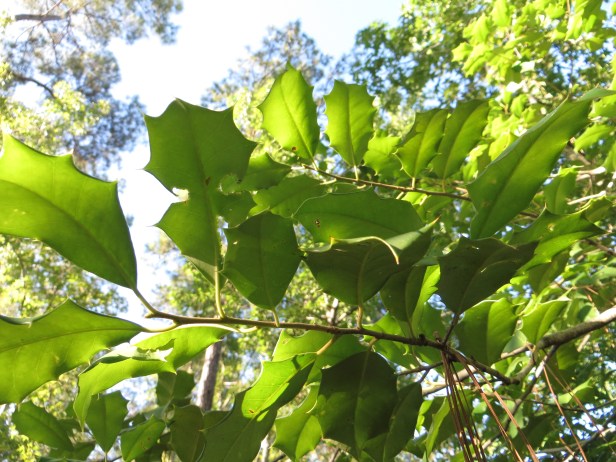
American holly (Ilex. opaca) seen in picture. Is one of the hardiest of the cultivated hollies, but is less colorful than either the English or Japanese species. Preferred varieties include Foster and Hume. These will survive and occasional hard winter if planted in the wind- sheltered locations such as on the east side of sheltering evergreens or on the east side of a house. They do best in full sun.
Chinese holly (Ilex. cornuta) is more sensitive to temperature and will stand dry air better than other types, which makes it practical for home plantings in Southwest. It seldom produces berries in climates where winter temperatures are 0*F. (-17.78*C.) or below.
 Care To Plant