

This is one of the most popular and important tropical fruits. Long-keeping and easily shipped, it is tasty, very digestible and rich in several major minerals and some vitamins.
Banana plants are rapid-growing herbs five to twenty-five feet tall. Their stalks or trunks are succulent, being actually composed of compressed layers of leaf sheaths. After bearing once, the stalks die back to the plants true stem, which is an underground rhizome (adventurous roots).
New suckers on which further fruit is borne are constantly rising from a healthy, productive rhizome. On a plant that is growing well, a sucker bears within 12 to 18 months after its emergence from the soil, but the length of time required to develop fruit may vary with soil climate.
A hole 30 by 36 inches and 18 inches deep should be prepared for planting either rhizomes or suckers. Dwarf Cavendish may be planted 8 or 10 feet apart; others should stand no closer than 12 to 15 feet. Plant the sucker or rhizome a foot deep, and fill the hole with mixture of topsoil and compost or rotted manure.
While the plant is young, remove all but one sucker, whereas it should be allowed to bear its fruit and be cut back before another sucker is permitted to grow. Older plants may be allowed to develop one new sucker every three months.
A plant will grow and bear well for 4 to 6 years, after which it should be dug out, the soil enriched and new suckers or rhizome pieces planted. After its first fruit has ripened, the plant maybe allowed to grow 3 to 6 suckers, any others should be dug up and planted in containers or an other area of ground.
Bananas are gross feeders, because of their heavy growth they need plenty of fertilizer and a large amount of moisture. They do best where the rainfall averages 60 to 100 inches per year. In areas where it is less than that, they will need frequently watering.
A heavy rich mulch should be maintained under the plants at all times. This may be rotted manure, compost or a mixture of manure and leaves or grass. Because they contain no viable seeds, banana must be propagated by separating the suckers from the parent plants or by making cuttings of the rhizomes. Suckers 2 to 8 months old are used and are moved in March or April.
Seven to ten pound cuttings of the rhizomes are removed, each with 2 buds, by cutting with a spade or mattock. Rhizome cuttings can be replanted immediately or held for a few days, exposed to the air, then planted.
Bananas require about 100-days to mature after the young flower buds appear. Bananas which are cut 7 to 14 days before ripening may be hung in a cool shaded place to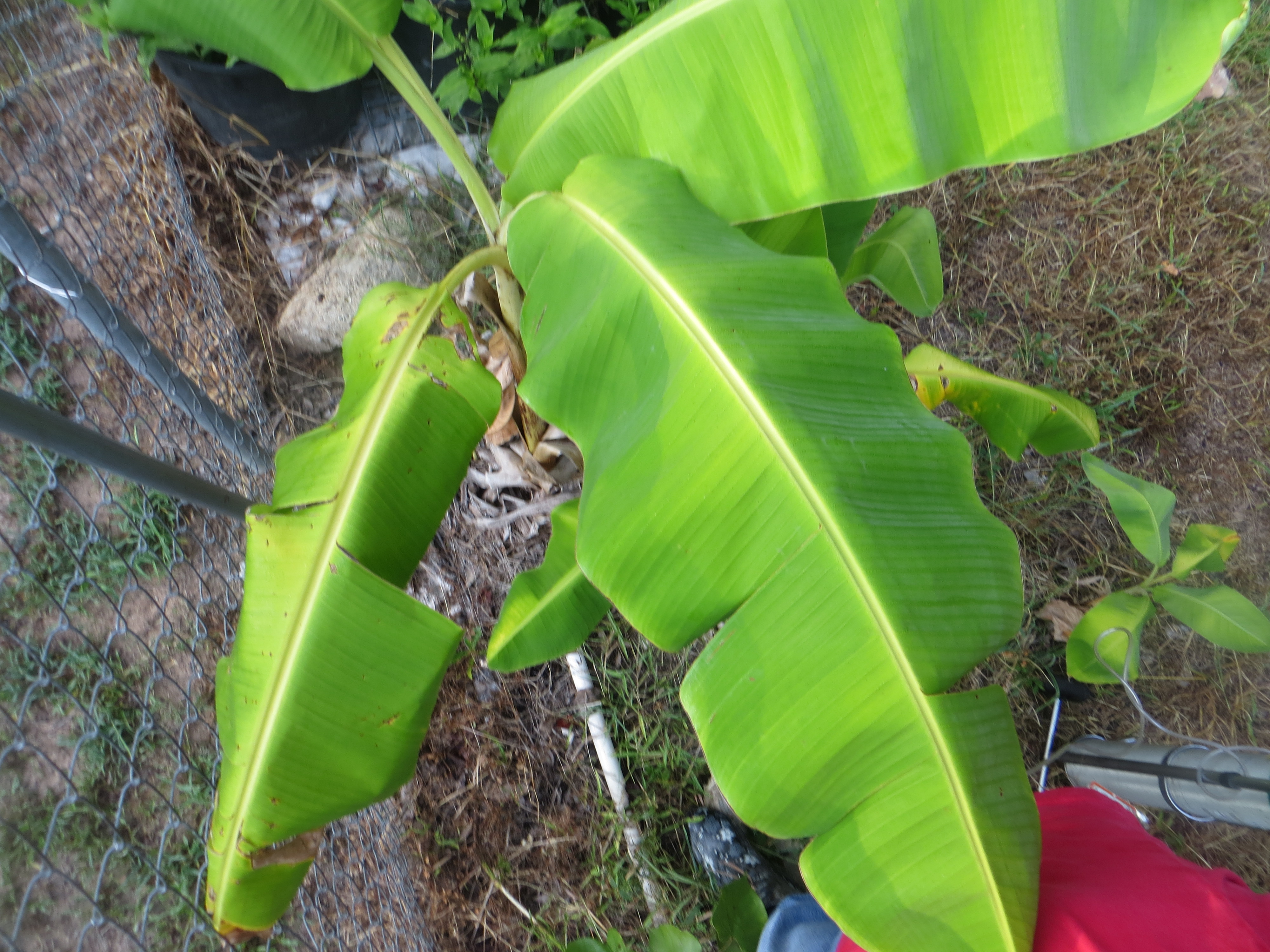 develop their flavor and sugar. Their nutritional value will be the same as that of 3 ripened fruit.
After the bunches are cut down from the plant, the ends of the stalk are trimmed and the bananas are held at room temperature until thoroughly ripe. Stalks of the plant are cut back and are chopped into small pieces which are added to the mulch around the roots.
The two main varieties are the common banana, which is imported type widely eaten as raw fruit, huge quantities being picked and shipped green and ripening to yellow only as they reach the consumer; and the Chinese dwarf banana (Musa acuminate cv. ‘Dwarf Cavendish’) which grows only 4 to 6 feet high and bears many very tasty fruits, (they last longer separated).
Since it is hardier than most varieties, this dwarf banana is better suited to culture in this country, and many are grown as fruiting ornamentals in gardens . They are grown indoors at home or business’s.
The Gros Michel is the largest eating variety, with a mild, tender flavor. These should be cooked if green. Separate as to life expansion.
Varieties which are used only for cooking are, in general, richer in vitamins than those which are eaten raw. In one medium-sized banana of the cooking variety, there are 420 units vitamin A;.04 milligrams vitamin B1; .06 milligrams vitamin B2; .6 milligrams niacin; 12 milligrams vitamin c; and about 100 calories.
In a dessert variety the amounts of approximately as follows; 120 units vitamin A; .03 milligrams vitamin B1; .05 milligrams vitamin B2; 6 milligrams niacin; 9 milligrams vitamin C; and 85 calories. Call it pure joy.
 Care To Plant