
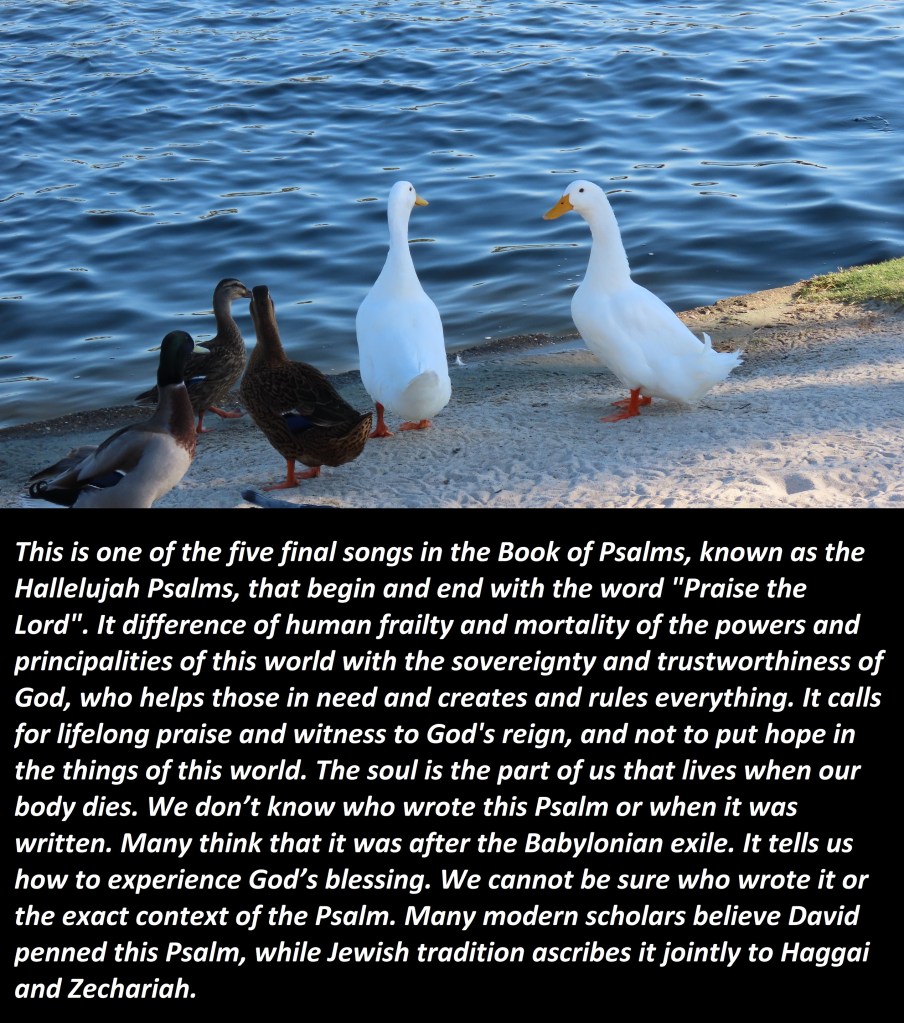
This is one of the five final songs in the Book of Psalms, known as the Hallelujah Psalms, that begin and end with the word “Praise the Lord”. It’s the difference between human frailty and mortality of the powers and principalities of this world with the sovereignty and trustworthiness of God, who helps those in need and creates and rules everything. It calls for lifelong praise and witness to God’s reign, and not to put hope in the things of this world. The soul is the part of us that lives when our body dies. We don’t know who wrote this Psalm or when it was written. Many think that it was after the Babylonian exile. It tells us how to experience God’s blessing. We cannot be sure who wrote it or the exact context of the Psalm. Many modern scholars believe David penned this Psalm, while Jewish tradition ascribes it jointly to Haggai and Zechariah.
Psalm 146:1-10 NIV
Praise the Lord. Praise the Lord, my soul. I will praise the Lord all my life; I will sing praise to my God as long as I live. Do not put your trust in princes, in human beings, who cannot save. When their spirit departs, they return to the ground; on that very day their plans come to nothing. Blessed are those whose help is the God of Jacob, whose hope is in the Lord their God. He is the Maker of heaven and earth, the sea, and everything in them, he remains faithful forever. He upholds the cause of the oppressed and gives food to the hungry. The Lord sets prisoners free, the Lord gives sight to the blind, the Lord lifts up those who are bowed down, the Lord loves the righteous. The Lord watches over the foreigner and sustains the fatherless and the widow, but he frustrates the ways of the wicked. The Lord reigns forever, your God, O Zion, for all generations. Praise the Lord.
 Care To Plant