
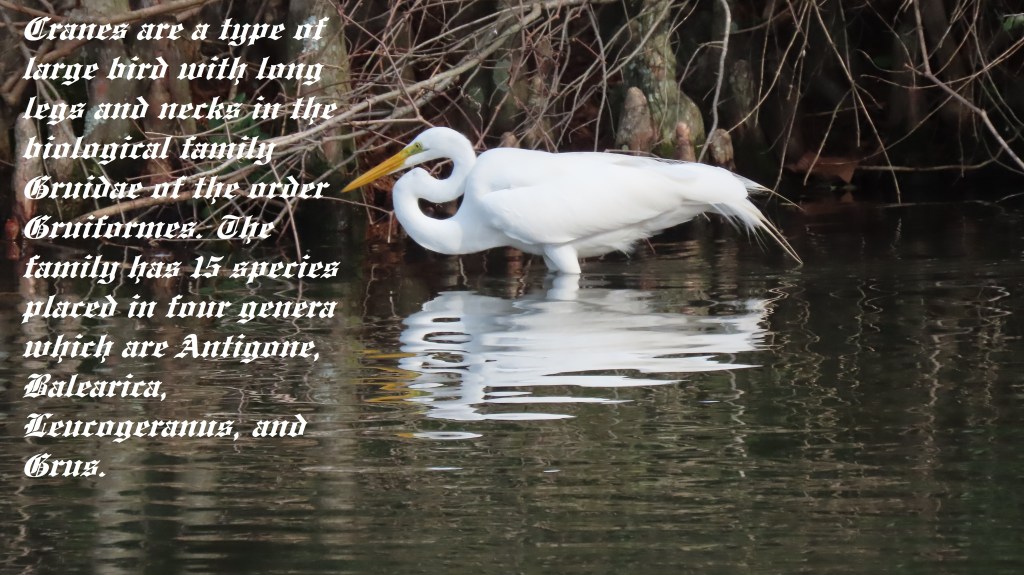
Cranes are a type of large bird with long legs and necks in the biological family Gruidae of the order Gruiformes. The family has 15 species placed in four genera which are Antigone, Balearica, Leucogeranus, and Grus. They are large birds with long necks and legs, a tapering form, and long secondary feathers on the wing that project over the tail. Most species have muted gray or white plumages, marked with black, and red bare patches on the face, but the crowned cranes of the genus Balearica have vibrantly-coloured wings and golden “crowns” of feathers. Cranes fly with their necks extended outwards instead of bent into an S-shape and their long legs outstretched. Cranes are carnivores and will eat a variety of animals, including snakes. They typically prey on small snakes, such as garter snakes and blind snakes, but will also eat larger snakes, such as pythons and boas. Cranes will eat just about anything, including seeds, grain, berries, insects, worms, mice, small birds, snakes, lizards, frogs, and crayfish.
Symbol of A Distraught Soul: In the Book of Isaiah 38:14, King Hezekiah, who was gravely ill and near death, cried out to the Lord. He likened his anguish to the chattering of a crane and the mournful cooing of a dove. The passage describes how Hezekiah pleaded with God, recounting his faithful life and good deeds. In response, the Lord granted him 15 more years of life and promised to protect the city from the King of Assyria. The unique sound of cranes, produced by their elongated trachea, symbolizes lament and distress.
A Symbol of Discerning Seasons: The prophet Jeremiah also mentions cranes in Jeremiah 8:7. He observes that storks, turtle doves, swallows, and cranes all follow their appointed times and seasons. However, God’s people fail to recognize and follow His law. The migratory nature of cranes serves as a reminder of discerning the right time and being attentive to God’s guidance.
 Care To Plant