
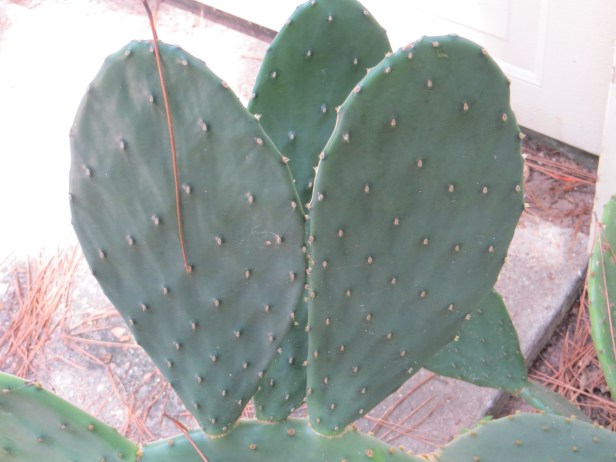
The prickly pear is one of the most important members of the Cactus family. Some are called cholla. They may be flat or cylindrical in shape, a few inches high or over ten feet tall.
The hardiest opuntia’s are (O. humifusavar. austrina, the common wild prickly pear of the northeast and central states, and (O. polyacantha), the low, round-stemmed cholla, which thrives outdoors up to North Dakota. Both of these grow on sandy soil, often, along shores, and have three-inch yellow flowers. They are easily transplanted from the wild or propagated from stem cuttings. (Do Not work with this plant without gloves. Plants need to be handle patiently with out force. )
The outdoor culture of the rest is confined to the Southwest, but they are favorite green house and house plants all over the country. ( Do not grow around children, unless you make them aware not to touch the Opuntia.) Nearly all have extremely sharp spines arising from masses of short, barbed hairs, and white, yellow or red flowers. The handsome fruits of many species are edible and choice. (Use gloves when peeling, research cooking instructions.)
Some of the smaller ones for window gardens include the thimble tuna (O. sphaerica), a dwarf, red- flowered type that grows in clusters; cinnamon cactus (O. microdasys var. rufida), with green pads spotted with short spines, and yellow or orange flowers; fairy needles (O. Soehrensii), growing in clusters with long spines and yellow flowers; rose tuna (O. basilaris), with pretty rose red pads and large pink blooms; and rabbit’s ears (O. micro-dasys), similar to cinnamon cactus but with plushy golden spines, and O. tuna is a low, prostrate cactus with yellow, red-tinged flowers and pear-shaped fruit called tuna.
There are also many large prickly pears, suited to greenhouse culture. They can be grown in tubs and put outdoors as garden accents in the summer. ( At a business setting you can add rocks to the decorate tub to add beauty to your environment)
(O. cylindrical), grows up to ten feet tall and is sometimes without spines.( O. imbricate) is about the same height, but shrubby and with large purple blooms. (O. fulgida ), eight feet tall, has a woody trunk and pink flowers. Nopal (O. Lindheimeri) grows about twelve feet tall and has three-inch yellow blooms and two inch purple fruit. The Indian fig (O. ficus-indica ) is cultivated throughout the tropics for its big juicy, edible red fruit. It is treelike, often fifteen feet high and usually spineless.

