
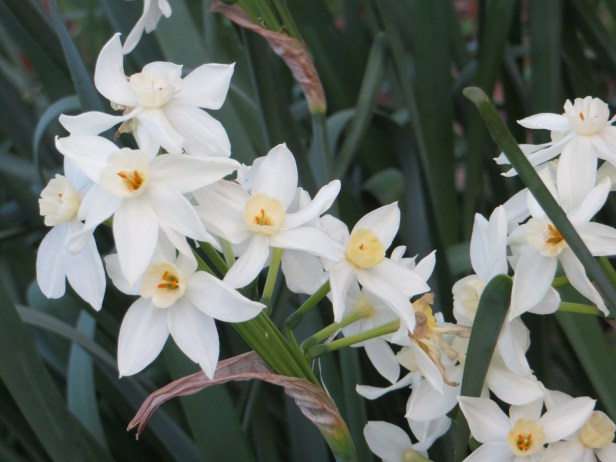
Daffodils, as well as all of the hardy bulbs, require an interval of low temperature during their dormant period before they will flower properly. That is why they must be planted in late September or October.
Daffodils are hungry plants and thus fast growers. Before planting, spade the soil to about 12 to 18 inches and incorporate generous amounts of compost and well-rotted manure. Peat moss or leaf mold may be applied liberally in sandy soil, and heavy clay soils should be loosened by working in sand and humus material, such as compost. These bulbs are very intolerant of raw manure, so be sure it is well composted.
Set the bulbs about six inches deep and six to eight inches apart. It is better to plant deep than too shallow, since the latter results in dwarfed plants. Be sure to press the flattened base of the bulb firmly into contact with the soil beneath it, as air spaces will delay the formation of roots or may allow rotting of the bulb to take place. The roots must be well established before hard frost.
Most bulb plantings do not require a winter cover, but in areas where winters are severe it is wise to mulch with straw, leaves, grass clippings, or pine boughs. Remove the cover early in the spring so you’ll let the small plants poking through have a breath of spring air. As with all the spring bulbs, let the foliage ripen naturally. They need to store energy for next year’s array of bloom.
Scatter the bulbs at random and plant them where they fall. Of course they look lovely in more formal landscapes, too, but keep them in clumps or groups, not in rows. Once planted, daffodils may remain four to five years before you need to replant them. Be sure they get a topdressing of compost each year to insure a good display of flowers. When the plantings become to crowded and blooms are small. It is time to dig up the bulbs, separate them, enrich the soil, and replant.
The type and forms available are varied and numerous. If you are interested in the double flowered varieties, try planting Mary Copeland or Texas. Some of the single flowered varieties are King Alfred, golden Harvest and Carlton. There are also bi-color varieties which are beautifully attractive, such as Spring Glory, Geranium and Dick Wellband. Bulbs are actually not time consuming in a landscape, that can have four seasons if done correctly, And well taken care of.

