
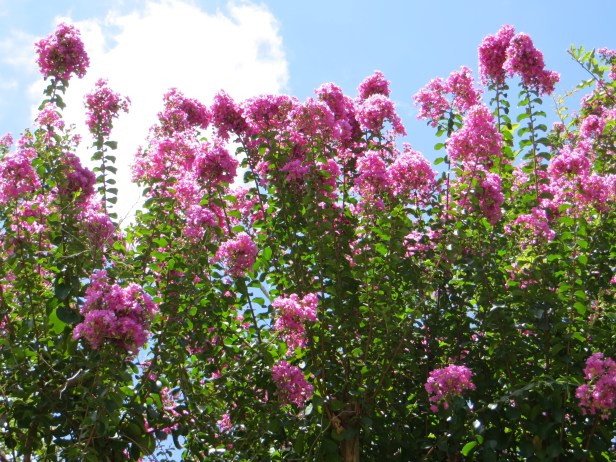
This is a genus of shrubs and small trees of the Loosestrife family. Flowers with fringed petals grow in loose terminal clusters, and may be white, pink, red, or purple, depending on variety. The blooming period lasts for several months in summer. Propagation is by seed or cuttings, which are easily rooted. Seedlings often produce bloom the first year, and cuttings either the first or second year.
Crape Myrtle (L. indica) is the principal species grown in the United States. It is hardy only in the South and North to seaboard Maryland. This Myrtle is root-hardy to Massachusetts if the roots are protected, but the tops will die back each year. Vigorous growth and bloom will follow the next spring. When grown indoors in a pot or tub, it is cut back severely each fall, and will bloom several times during the year. Young plants grown outdoors in the South must also be cut back almost to the ground after blooming, or growth the following year will go into foliage and the bloom will be sparse. A dressing of manure or compost should be spread around plants in spring. After root systems have become large enough to supply food for both foliage and flowers, heavy pruning may be continued if a shrub is desired or lighter pruning if it is to become a flowering tree. Trees attain a height of about 20 feet. Like the one in the picture.
Queen’s Crape Myrtle (L. speciosa) is a tropical tree growing to 50 feet that is suited only in southern Florida and southern California. Its mauve to purple flowers grow to three inches in diameter, and its leathery leaves to one foot long. It is extremely showy when in bloom.

