
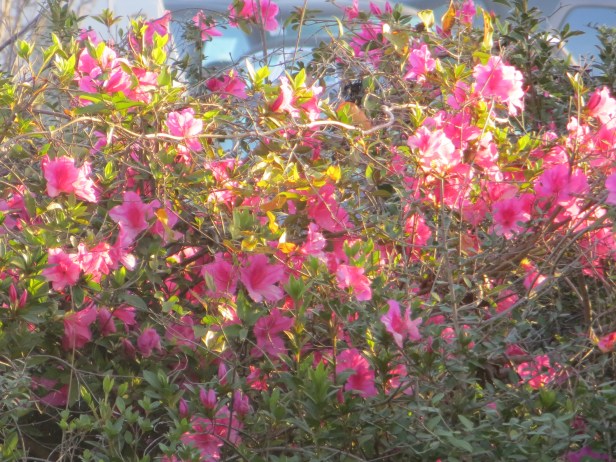
This shrub is either evergreen or deciduous, and with the advent of spring it comes into its glory. Suddenly the tip of each branch bursts into bloom ; for sheer beauty few other plants are its equal.
Actually the azalea is the lazy gardener’s dream plant. Rarely, if ever, will an insect or disease do serious damage to a vigorous azalea. Most of the plant’s ailments are caused by poor nutrition or an unsuitable location.
Its requirements are simple but rigid: acidic soil, a heavy mulch, constant moisture with good drainage, filtered sunlight and no cultivation.
The required acidic soil should be achieved by organic means. Decayed pine needles have high acidity. Oak leaf mold and the decayed sawdust from oak, cypress, or hemlock are also acidic. If the soil is alkaline, it would be best to dig out the area and replace with acidic soil. This may seem like a lot of trouble, but it will make care of the plant simpler.
Acidic soil may be obtained from pine or other coniferous forests or from the woods where acid-loving plants such as mountain laurel and blueberry are growing. Coarse sand and leaf mold will make a loose, crumbly soil that retains moisture yet gives good drainage. The azalea will thrive in such soil, and after planting, the acidity can be maintained by proper mulching.
The importance of mulching azaleas cannot be overemphasized. The roots are extremely shallow-most of them lie within three or four inches of the surface-and they must be kept moist at all times. They must also be protected from the heat of summer and the cold of winter, and they must never be disturbed by cultivation. A mulch of at least four inches is necessary. The mulch will keep down weeds and is the natural home of frog and lizards which eat many insect enemies of the plant.
Pine needles, oak leaves and sawdust from oak, cypress and hemlock make excellent mulches. Many growers find that a combination of pine needles and oak leaves is especially good. The needles keep the leaves from blowing and are high in acidity but slow in decaying. The oak leaves decay more rapidly and, while lower in acidity, are higher in food value. Seaweed added to the mulch from time to time will add trace minerals. (See, going to the beach on vacation, has it’s benefits.) Manure is not recommended for azaleas because of its alkaline reaction.
The most common symptom of an ailing azalea is chlorosis or a yellowing of the leaves. this usually means that the soil is not sufficiently acidic. It may be prevented by proper planting and mulching. If the condition appears in spite of these precautions, check the water supply. Sometimes the water contains lime which counteracts the acidity of the mulches.
Other than the food from the decaying mulch, azaleas require only a feeding of cottonseed meal once a year to keep them in good condition. This feeding should be given immediately after the blooming season and applied at the rate of 2-1/2 pounds per 100 square feet. It should be sprinkled over the mulch and watered in. Because of the shallow roots, do not dig any fertilizers into the soil.
If the plant seems to lack vigor, a second feeding may be applied three weeks later, but never after the last of June. Later feeding will encourage new growth that will not be hardened before the heat of summer begins.
Azaleas need some sun to bloom satisfactorily, but the direct rays of the summer sun are usually harmful. The buds for the coming spring form during the summer and fall, and the plants need plenty of moisture during that time. Any baking by the sun will result in a shortage of blossoms. The plants wilt quickly if not kept moist and are slow in recovering after even a single drying out. They will thrive best in the edge of woods where they get filtered sunlight, or in sheltered locations. They also need some protection from the wind, which will damage the blossoms during the blooming season.
Winter hardiness varies with the different varieties and with the condition of the individual plant. In general, the Indica varieties are perfectly hardy only in the South, while the Kurumes are grown successfully as far north as Long Island.
Plants grown in dense shade or those which are overfed or fed late do not withstand cold well. All growth should be matured before winter. The plant will survive severe cold if the roots are protected, but the flower crop may be injured by unreasonable cold, especially after the buds are showing color.
Azaleas are pruned to keep them at the desired size and to make them produce more flowers. Ideally, the plant should be thick headed and well branched since a flower forms at the tip of each branch. Pruning should be done immediately after blooming
so that the blossoms can form during the summer.
The colors range from white through pink, lavender, salmon, orange, and red. In small gardens a single color is most effective, especially when combined with plants of the same color which are in bloom at the same time.
The azalea is exacting in its requirements, but once those are met no other plant is more rewarding. Other than its uses as an outdoor plant, it is a long-lasting cut flower. Further-more, because of the compact, shallow roots it is easily transplanted.
During blooming season the entire plant may be lifted, potted and moved into the greenhouse, or house. Then it can be replanted without damage.
It show can spice up a room.

